Friday, July 8, 2011

Chef Quote of the Week: Anthony Bourdain

"I was about getting the biggest paycheck then, so I could see music, smoke expensive weed, do cocaine, that kind of life. It was less important to me that I would get good at my craft. I deluded myself into thinking I was good."   Chef Anthony Bourdain


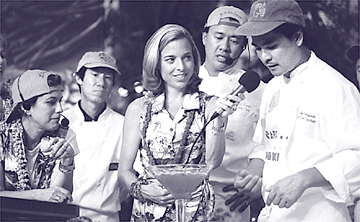
Biggers with Roy Yamaguchi
 In the age of oversaturation of reality shows, we have reached a perverted gladiator-style of entertainment, and the arena is the kitchen.  We've come a long way from the Food Network's "Ready, Set, Cook!" in which perky host Sissy Biggers egged on a studio audience to cheer for their favorite cook as they raced against the clock to create a dish from a mystery basket of ingredients.  The winner was decided by a majority of flashcards held by the studio audience depicting either a tomato or a bell pepper for their favorite contestant. 

Today, debasement, sabotage, plot lines, humiliation and real live injuries are not just common, but necessary to attract viewers.  It is the Wild, Wild West, and there no heroes, just survivors.

So, it's very rare when a ribbon of truth ekes out into the MSM about what it's really like in a professional kitchen.  And, when it does, it seems to fall on deaf ears.  This is why I chose to make Anthony Bourdain my "Chef Quote of the Week."

Successful author and TV personality Bourdain recently had a very (public) self-deprecating moment, and it was directed at a portion of the audiences who one day aspire to culinary greatness.  He calls it "My Favorite Mistake".

"If you’re serious about cooking and your craft, do the opposite of what I did."

Read the full piece in Newsweek here.

Tuesday, July 5, 2011

F&C Rewind: Feeling Crabby

If there is one item I could live without ever ordering, preparing or seeing on a menu again, it's the crab cake.  It's become the most egregiously made, bastardized dish throughout the mid-Atlantic, with variations so vast, it's no wonder locals are so visceral in their opinions on the subject. 

For me, it begins with what people come to expect in a crab cake.  If there is anything other than boulder-sized chunks of crab in front of them, they complain of "too much filler".  Ughgh.  I'll get back to that, but I think it must stem from what people don't know about making these local delicacies.  The crab cake should be primarily crab with seasonings that complement the sweetness of the meat.  It should be moist and tender, properly seasoned, and it should hold together as it slides off a spatula and onto your plate or bun.  

Smarter cooks know that the fewer ingredients you use in a dish, the more you must respect the ones you do use. All those lovely lumps of precious crabmeat are held in trapezoidal compartments within the crab, and they're delicately extracted and separated into and sold as the valuable categories of jumbo lump, backfin, lump and claw meat.  Experienced crab eaters would never discriminate and abandon all the briny goodness that comes from eating all the various types of meats from their crustacean cronies.  But, try using something other than jumbo lump, and the average Joe screams heresy.  They are unaware that the only way to keep a crab cake bound together is to use complementary ingredients that help hold them into the signature "cake" form.  The intense and sweet flavor is often given from using a combination of the jumbo AND claw meat.  The delicate nature of the claw/leg meat (like that of the Jonah crab) also helps to bind when mixed with the base.  So, my ill-informed filler-fanatics, crab claw meat that binds, is still crab.  It's a wise use of crab meat and if you are going to produce them in volume, it helps keep them at a reasonable price.

Typically a little bit of egg, bread or mousse combination is used to help bind these two flavorful types of crab meat.  Egg alone will not do the trick, but adding fresh white, doughy bread crumbs, like from Wonderbread, help hold the crab together.  Taking the protein of shrimp or scallops and combining in a processor with egg white and heavy cream will give you a delicate mousse that is both flavorful and does the trick nicely of binding the crab.  Beyond that, what else you put in is a matter of taste.  Avoid putting in anything that will detract from the main flavor or cause too much moisture or dryness, and you've got your own personal version of the dish that made Maryland famous.  So, why then do so many of them suck?

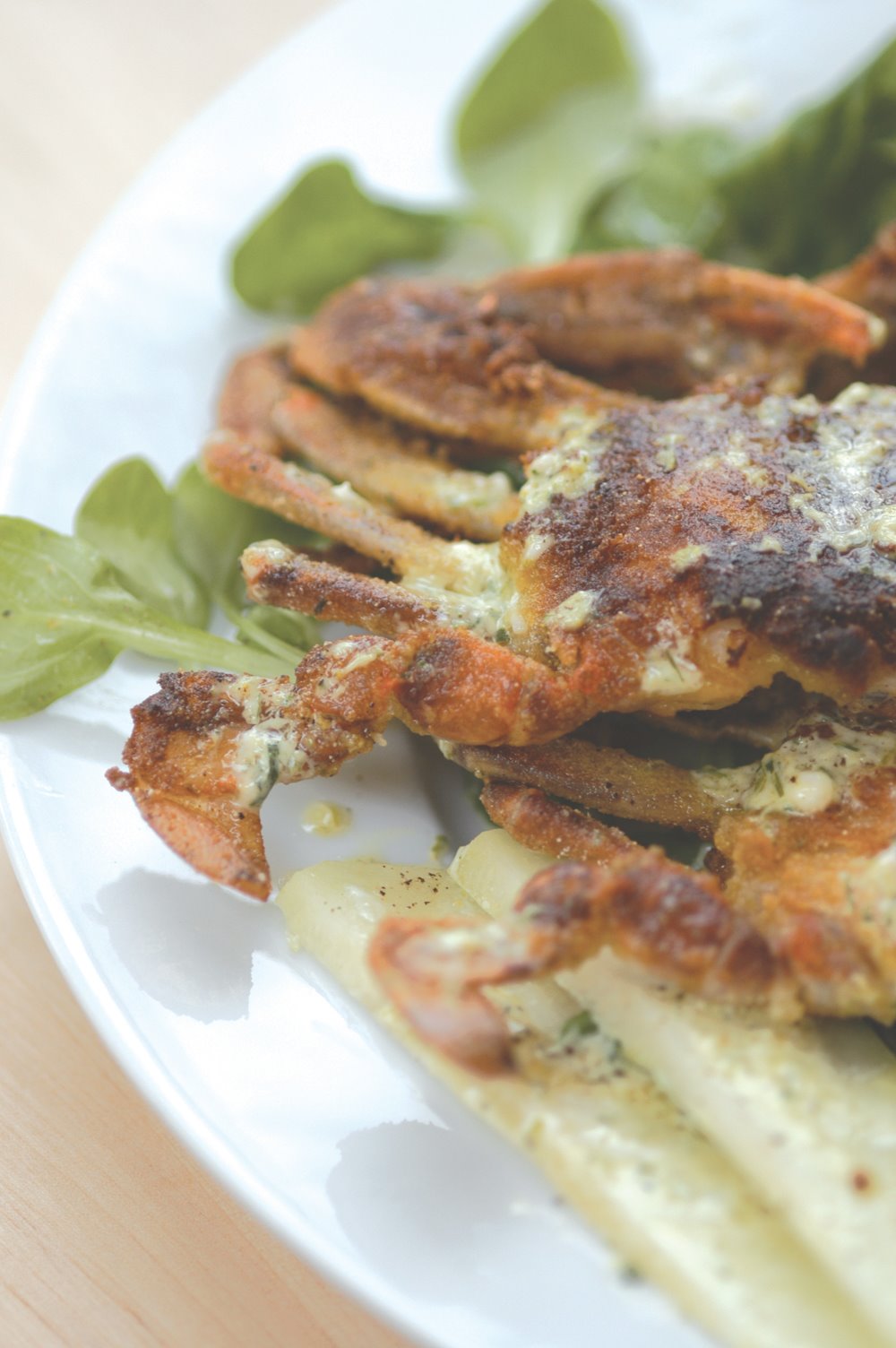
For all the crab cakes I loathe, it is mostly because they are mass produced for a homogenized appeal.  Each chef has their own idea of what a good crab cake is, and very often it's one that appeals to the masses.  Nothing wrong with selling a lot of crab cakes, I suppose.  Hey, Yugo sold a lot of cars, too.  But, I'm long since past ordering one in a restaurant, simply because I know I will be disappointed.  Give me a softshell crab, on the other hand, and it successfully captures all the things I love about a properly made crab cake:  crispy, toothsome texture, held together nicely in it's own natural sauce and it's as about as "pure" as it gets.  Slap on a little remoulade or equally gooey-tart sauce on a toasted, buttery bun, and my hankering for a sandwich of fresh crab is satisfactorily sated.

I don't hate the crab cake.  Really.  And I'm certainly not being snobby about it.  In fact, I love them so much, it's out of respect for their uniqueness that I sound off.  So, I guess you could say that I am being a bit of a purist.  And, just to show you how much I care, I'm going to share my recipe as long as you promise to make them for only two people.  Four, at the most.  And not another crab cake more.

The main concept behind making this version of a crab cake for only a few people is that it forces you to concentrate on following the recipe and to not cut corners.  Additionally, when you've mastered making these, you'll feel as though each time you make them again, it will be for people you really love and want to spoil.  You'll be giving them something they can't get anywhere for any price!  Now you know why some chefs don't give up recipes.  So, for you, my faithful Fork-N-Corkers, I am willing to make an exception, all in the name of respect for that little puck of tide-water goodness: the regal crab cake.

Robear's Secret Crab Cake Recipe
Makes four 5 oz. crab cakes
  • 8 oz. fresh jumbo lump crab meat
  • 8 oz. fresh crab claw meat
  • 1 small onion, small dice
  • 2 ribs celery, small dice
  • 4 oz. whole butter
  • 3 leaves fresh basil
  • Juice of 1 lemon
  • 1 teaspoon Old Bay seasoning
  • 1 dash or two of Tabasco
  • 1 dash of Worcestershire sauce
  • 1 egg
  • 1/4 cup mayonnaise 
  • 1 tablespoon dijon mustard
  • 2 pieces fresh white bread, broken into small pieces
  • Salt and White pepper


In 2 oz. of butter gently cook the celery and onions until soft.  Do not brown.  Add the Old Bay and basil.  Remove the mixture including the butter and set aside to cool.  


Combine the wet ingredients in a bowl and mix until just combined.  This is your base.  After you pick through your crab to remove shells, you will use it to bind the crab together along with the bread crumbs.  Season with salt and dashes of white pepper.  TASTE!  If you feel as though you could eat the whole thing right there, it's ready.  Fold the crab, fresh bread crumbs and some of the base together until it can hold it's own shape.  Resist using the entire mixture.  You are meant to have extra, but this is where people screw up:  when they add all the base, they try to compensate by adding more bread to dry it up, and this is where the perception of "too much filler" comes from.  You can always add more if you really need it, but the key concept here is to barely bind those ingredients together without turning it into a seafood meatball.


Form four cakes onto a plate, cover and refrigerate for at least an hour.  This is also a key step: don't skip it!


When it's time to cook, turn your oven to 355F.  In a non-stick pan, put a couple tablespoon of oil and heat the pan to medium hot (only lightly smoking).  Use a spatula to gently lift the crab cakes and place them in the pan.  Add the remaining 2 oz of butter now.  First, the pan will sizzle, then it will subside.  It will build back up to a hiss first (that's the steam) and then finally return to a sizzle.  When you see that the edges are beginning to brown, use your spatula and with both hands slowly turn the cakes.  Place the whole pan in the oven for 12-15 minutes.  Serve immediately from the pan.  


Open some pinot blanc, Macon chardonnay or other white to complement the sweetness of the crab.  Bon appetit! 


Saturday, July 2, 2011

A June Chef's Table


The Chef’s Table
at the
University and Whist Club
Of Wilmington
June 17, 2011

Reception
Crab and Corn Fritter~ Yellow tomato cocktail sauce
Venison Tartare
Matanzas Creek, Sauvignon Blanc, Sonoma County, 2007
Denver Leg of Venison provided for a nice alternative to beef tartare.  Balsamic caviar beads provided an unexpected burst of sweet and tart.

Sweet Corn and Crab: a classic pairing.  Yellow cocktail sauce was stripped down to its basic components: fresh horseradish, fresh tomato, vinegar and sugar.


Fresh hydrangeas were rescued from the yard.  In summer the club is surrounded by alternating powder blue and rust-purple blossoms.


Amuse Bouche
Chilled Tomatillo Soup
with Sope, toasted cumin and Fava Bean Puree
Chateau St. Michele, “Eroica” Riesling, Columbia Valley,
Washington, 2008
This close-up of the garnishes for the soup features a warm sope, corn relish, cilantro blossom and fava bean puree.

First Course
Mediterranean Mussels
Leeks, tomato, tarragon, semolina
Joseph Hofstätter, Pinot Bianco, Atlo Adige, 2009

Ten pounds of Mediterranean mussels gave their lives for this course.  Here they are simmering in leeks with their steaming liquid, white wine and butter.


With their counterparts: tomato, tarragon and toasty semolina bread.

Second Course
Veal Cannelloni
With Hand-packed ricotta, beech mushroom and sweetbread ragout
Domaine Dominique Guyon, Bourgogne,
Hautes Cotes de Nuits, 2009


Continuing with a course of hand-made pasta, a veal ragout and artisan ricotta fill a cannelloni, while beach mushrooms and sweetbreads back up the earthiness.

Intermezzo
Watermelon, Tomato Vine and Basil Sorbet


Main
All-Natural Dry Aged Beef Loin
Braised beet greens, poached garlic and sauce foyote
Marchesi Antinori, Tignanello, Tuscany, 2007


A whole strip loin was slow roasted and carved to order.  Placed atop tender braised beet tops with a traditional bearnaise sauce enhanced with fortified veal stock and roasted garlic cloves.  Magnificent with the Tignanello.

Cheese
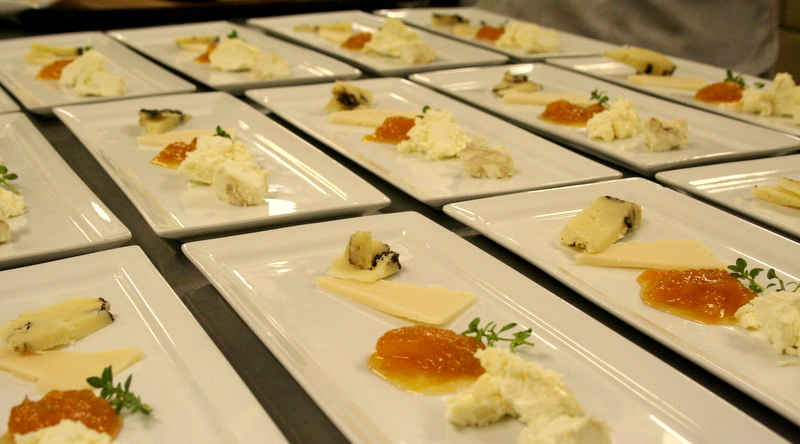
Goat Cheese Tasting
Cowgirl Creamery “obanon”, Toma Della Roca, Midnight Moon
And Moilterno al Tartufo; macerated apricots

One of my favorite cheese courses yet, the truffle cheese was just as exciting as any- but the apricots macerated in riesling stole the show.


Dessert
Cherry Clafoutis
with Armagnac and Honey Ice Cream
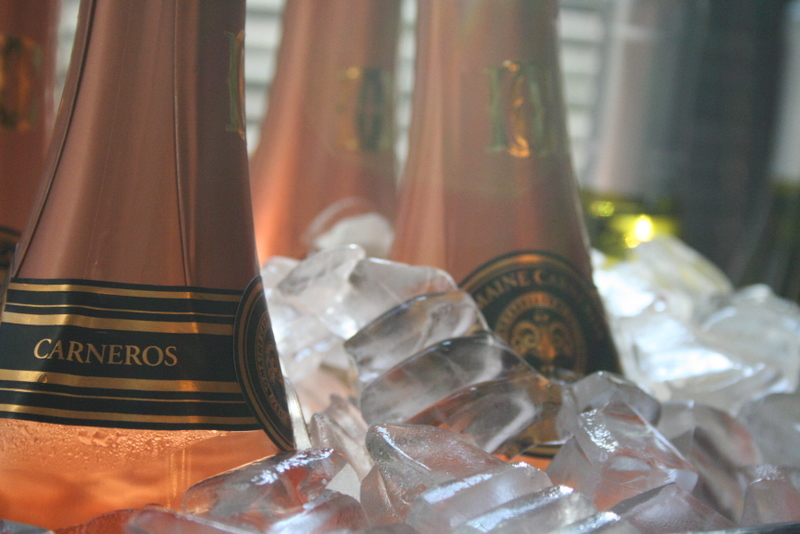
Domaine Carneros, Rose “Cuvee de la Pompadour”, NV, Carneros


Perhaps one of my favorite desserts of all time, the classic Cherry Clafoutis, here with frangipan and cherry-port reduction.  The ice cream lent a decadent richness hard to put into words.


This wine (and winery) is very underrated.  Nearly all pinot noir, the fruit was superb for the clafoutis, and another refreshing summer course.


Friandises

French Macarons
Strawberry, pistachio, Lemon and Praline

Our pastry department came up big with these textbook French macarons. 

Tuesday, June 21, 2011

Store Wars

We all have a favorite grocery store, that place we can go for everything from the simplest of items to the whole shopping list.  Some are luckier than others.  Living next to a Super G, for example, must be one of the happier things in life to happen to foodies.  Whole Foods is like Disney meets Trader Joe’s, truly a capitalist grocery if e’er there were one.  Then there are those unfortunate few who are landlocked, trapped from civilization and unable to get common items like coffee filters, chicken or milk.  The Trolley Square Acme in Wilmington, DE is one such store.  Maybe landlocked is not quite correct.  Black hole is more like it.  Its lack of usable products and cast of certifiably looney-bin customers earn it a place in our hearts.  The place where acid indigestion begins.

Locals have a hate-hate relationship with our ACME.  We bitterly refer to it as the SMACKme, the CRACKme or more appropriately, the SOVIET ACME, where long lines and no food are the norm.

I can honestly say that I'm desensitized by its user-unfriendliness.  After all, I lived in Cape May, NJ for awhile.  The ACME there makes Trolley look like Beverly Hills.  Because there are only about six aisles, it isn't uncommon to find barbecue sauce in the same row as Band-Aids.  Which is great if you're making a haunted house.  Very often you can spot birds flying around the store, a hazard most aren't used to navigating while shopping for food.  Year round you can buy a styrofoam cooler, but only three weeks of the year can you find avocados. 

Speaking of avocados, our beloved Trolley ACME has recently diversified their produce aisle, placing like-used products together, i.e. tomatoes, garlic and basil in the summer.  So, avocados can likely be found in two or three different locations now.  But, that doesn't increase the chance of ever finding a ripened one.  Ever.  My favorite is their 10 for $10 promo.  After all what's better than one unripened avocado but 10 unripened avocados?  But, I'm being insensitive and elitist.

It's like a big game of craps.  You never know if you're going to hit.  Many times I've gone in with a list of 8 or 9 items, half of which I couldn't find.  Usually then, I just abandon my basket and walk out.  I've got to head to another store anyway, so, might as well.  It also helps take the sting out waiting in the two lines that are open, knowing you only accomplished half of what you came in for.  More intriguing than not being able to find simple staples has to be the things I have found.  As a chef, I am often stiffed by my purveyors for odd items or items that come only in huge cases when I'm just in need of one.  Against all odds, I make the trek to Moscow and begin my search.  

"Ummm- do you have gooseberry jam?" I half-jokingly ask.

"Aisle 2".

What the what?  

Can't find sliced pumpernickel bread, but sun-dried cherries and matzo balls are always on the shelves.

There are some days I don't mind being called "babydoll", and others I could go ballistic.  Like, "Babydoll, c'mon over here, my line is empty."  Yay.  
But, "Can't you see my light is OUT?  This line is CLOSED, Babydoll!"  Picture Michael Douglas in the movie Falling Down.

I'm grateful for the local elderly patrons who walk to the store to shop, because at least I know they aren't on our roadways.  They seem to have absolutely no peripheral vision what-so-ever or awareness of personal space.  I begin to hum a particular Ludacris song at this point as I navigate these obstacles in my cart with only two working wheels.


The characters you see there are right out of a John Waters film.  My Duchess, as I like to call her, has straight-up Cindy Brady length gold braid extensions anchored by a fine velour Fat Albert and the Gang cap.  She wears a full-length winter coat no matter what time of year it is, and her makeup on any given day could hide her 75-plus years, or scare the hell out of little children.  Make that little children and adults.  My mind races as I stare into her cart at the 100 cans of cat food, Freihofer's cookies and epsom salts.  Must.  Get.  Out.  NOW.


Lastly, the self-checkout lines.  If you cannot check yourself out faster than one of the clerks here (and this is saying something), you have no business being in these lines.  They are built for speed, and I dare say, for people just like you and me who have no choice but to shop there, yet need to get out of the store before our mental health insurance plan is activated.  Deep breaths.  Deeeeep breaths.

Tuesday, June 14, 2011

Chef Quote of the Week: Sam Sifton

Not a chef, but one who thinks like one for a living: Sam Sifton is the New York Times food critic and restaurant reviewer.  He's in good company with a long line of other writers whose tenure typically lasts about 5 years.  They can make or break the reputations of the greatest restaurants in the greatest restaurant city in the world.  Today Sifton reviews Masa, the sushi and Japanese cuisine temple located in the Time Warner Center a few steps from another mecca of cuisine, Per Se.

The most surprising thing revealed to me in this review was the cost of a meal at Masa.  When it opened in 2004, a meal was $300 per person, not including tax, tip or anything to drink, and for awhile, it was on my list of restaurants I would like to visit.  Today, $450 is the price tag, making the cost for two who "do it right" (that is to say, drink well and tip on the whole thing) cost upwards of $1500.  For hardcore foodies, it's a price worth paying to surrender your control to the master of ceremonies, Masayoshi Takahama as he sends out course after course of whatever he feels like.  I've friends who forewent a honeymoon to eat here.  So, Sifton explains what happens when psychologically you expect the absolute best (as in four stars), and don't consistently get it.

"New York City now demands of its four-star restaurants an understanding that culture at its highest must never feel transactional, whatever its cost. We ascend to these heavens for total respite from the world below, for extraordinary service and luxuriant atmosphere as much as for the quality of the food prepared."  Sam Sifton

Photo courtesy of New York Restaurant Insider
Sifton has nailed a very important idiom here:  as we move into the economic unknown of tomorrow, we will constantly adjust our standards of fine dining based on what's happening today.  Perhaps that is why in 2004 Frank Bruni awarded Masa four stars, the highest rating attainable.  When you surrender $1500 of hard-earned cash for a meal, "perfect" is a word that should come up more than a few times when describing it to others.  

LinkWithin

Related Posts with Thumbnails