Showing posts with label Old vintages. Show all posts

Thursday, August 30, 2012

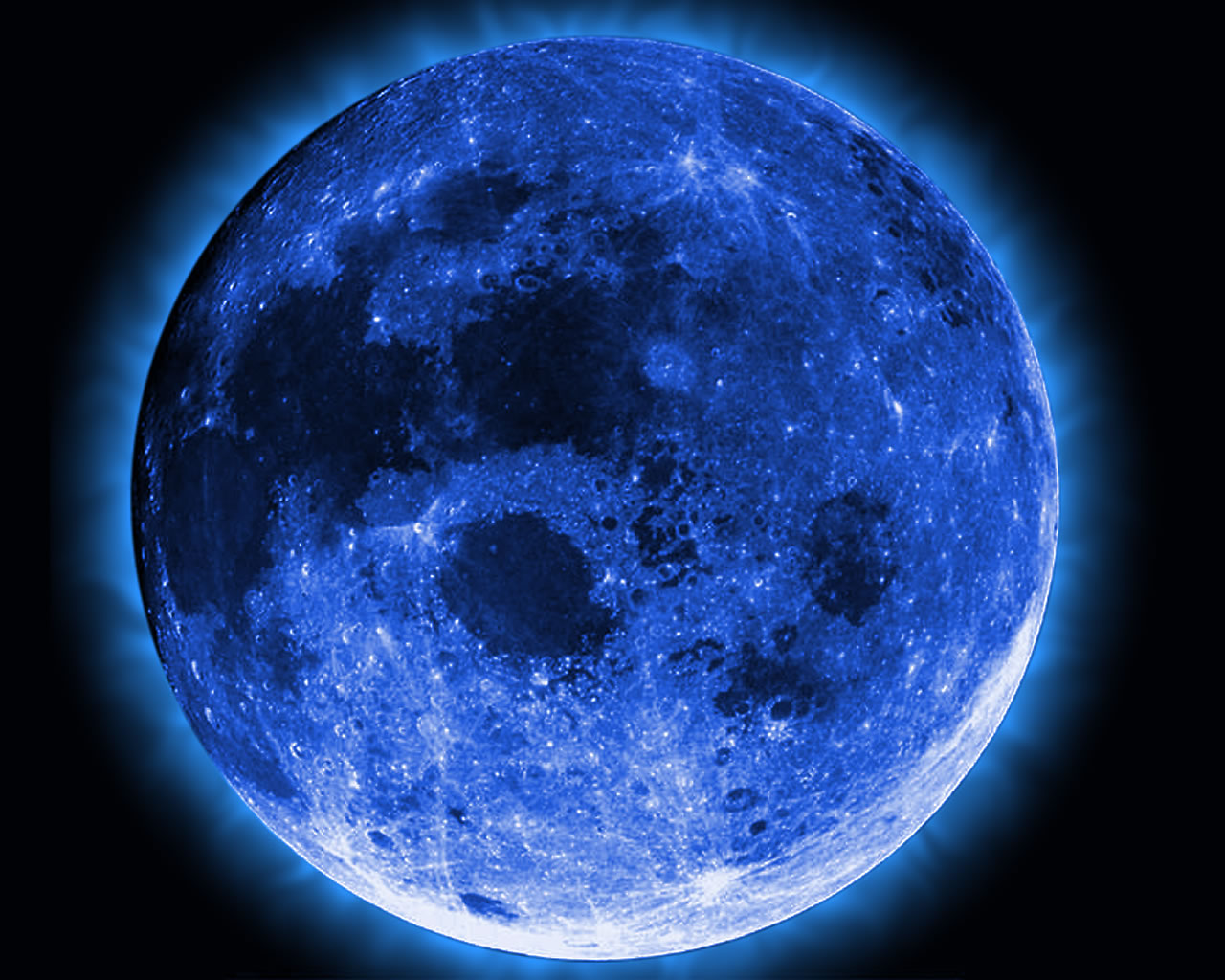
3 Years and a Blue Moon, Again


Three years ago this week (8/27/09) I began ForknCork.  With not much of an idea about what I would blog, I set forth and let the creative process develop.  It's been a very rewarding experience, and one wholly self-indulgent.  Rather than reflect on posts of the last three years, I decided that in observance of tomorrow's Blue Moon, I would re-post my Blue Moon post from October, 2010.    It's a tribute to really rare wines, delicious food and very good friends.  That pretty much sums up, for me, what ForknCork has been about.  Enjoy.


A "blue moon" is one of those over-used superlatives indicating something so rare and so fancy-pants that everyone should take note.  I admit it's both fun, but trite to use, but then my friends and I didn't really consider that when we dubbed what we thought was a once in a lifetime opportunity to taste uber-rare wines, while attempting to pair lofty cuisine worthy of their pedigree, would be the first of...more?

While a true lunar blue moon occurs when there is a second full moon in a calendar month (that's about 7 times every 19 years), we truly thought our opportunity was more akin to the mythical type (you know- like almost never?) than the literal.  Yet, math was on our side.

Last year, I blogged a dinner amongst these same friends that documented the very scenario above.  Given the enormity of it's rareness, we thought we were not likely to see one again, any time soon.  It featured some of the most precious and sought after wines in the world- including a 1975 Chateau d'Yquem, multiple first growth bordeaux, a 1963 Vintage Taylor Port and a 1919 Chateau Haut Brion, all provided by a passionate food and wine lover simply because he saw the enthusiasm with which we produced the first menu.  It was, like the first time 10 years earlier, a night to remember. 

Two months ago I got the call that our benefactor was coming back to town for business, and he wanted to do it all again, just 14 months later.  As with the first two times, he chose 12 wines from his expansive and impressive cellar, emailed us the selections, and then shipped them overnight with painstaking care.  Except this time, we had not six weeks to prepare a menu and line up our game plan, but three.   

When faced with the prospect of pairing world-class wines from first-rate vintages, you don't think about busting out the molecular gastronomy and culinary bells and whistles.  It's all about the classics.  Example:  a pairing from the first dinner 10 years earlier, which will forever be indelled in my memory, was as simple as it was brilliant.  A 1962 Domaine de la Romanee-Conti "La Tache" was paired with a locally raised, braised rabbit leg with parsnips and local mushrooms.  Simple.  The rabbit was simmered until "confit tender". 

It wasn't until days before our seafood purveyor, of all sources, queried whether we'd be interested in taking some fresh Maine wild blueberries that were being brought in by the same guys who were shipping day-boat halibut.  The answer was a resounding, "DUH?".  And so, to bridge that all important gap between what could be a white wine course or a red wine course, we added the berries to our braising juices and let them simmer.  The result defines the term "sublime" (there was another impressive Burgundy paired with the dish from an equally impressive producer and vintage- but, the la Tache was so incredibly on point, and our elementary rabbit dish was so wonderfully complementary, that it silenced our group).  Its extraordinary complexity and delicateness commanded a moment for us to regroup our thoughts before continuing.  The perfect balance of components, married with a harmony of fruitiness, acidity and earthiness leaves me swooning to this day.  Such is the power of the classics.
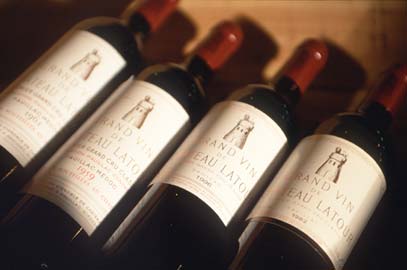
Sticking with that formula, a forward team that consisted of just myself and my surrogate "chef brother" Paul met one steamy, humid Sunday eve last month to handle the latest challenge.  We gathered our notes on the latest round of wines, and, to lend some inspiration, we opened and reverently sipped a 1990 Chateau Latour.  As is common, we aligned the wines in order of likely service and fleshed out an outline of the basics:  main component and main flavor profile.  With 12 wines slated for consumption, we decided to pour two per course, with the dinner lasting at least six courses (supplementary wines are often added by equally passionate attendees).  But, we knew the crux of how it would all go down.  We had only three days after that to consult a couple other possible chef friends who would participate to fine tune and finalize the menu, order our special ingredients and prep.  All this while working our full-time jobs, managing our personal lives and performing our duties as Pere de la Maison.  Challenging? Yes.  Fun? Of course!  Nerve racking?  Well... you answer.  The previous two dinners had consisted of no more than 10 attendees, and the most recent was looking more like 7 or 8.  No matter, it like the others, had to be perfect.

Why does great wine command such respect and awe?  Like architecture, it's man's greatest achievement of harnessing nature to produce a product solely for the purpose of his pleasure.  

The menu was finalized and the pieces fit into place, as they so often do.  Pairing food and wine is an art, yes- but, it also becomes an exercise in common sense.  Delicate wines require delicate preparations, aggressive ones need a little push.  Never repeat ingredients.  Create diversity of textures and temperatures.  Contrast and complement.  Multiple courses should build in intensity then back down- begin gentle, finish gently.  Leave the table sated, not stuffed.

Despite how it may read, the following menu and wines were the final choices, and they followed all the guidelines above.  The pictures, of course, tell the real story.

Warm up: A little pre-game with Charles Gardet & Co.


1st Course
Ragout of Veal Sweetbreads “Blanquette”- with beech mushroom, local sweet corn, tarragon and veal jus (not pictured)

2000 Chevalier Montrachet~ Bouchard Pere et Fils
2000 Montrachet Marquis de la Guiche~ Joseph Drouhin


2nd Course
Braised Oxtail over quinoa and Doctor Martin lima beans - with thyme infused braising juices

1989 Chateau Mouton Rothschild~ Paulliac
1989 Chateau Lafite Rothschild~ Paulliac
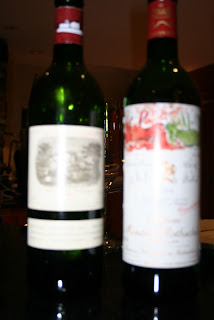
A little "fuzzy", I know- but trust me. 


3rd Course
Crispy Colorado Lamb Rillettes – risotto style “potatoes” and hen of the woods mushrooms
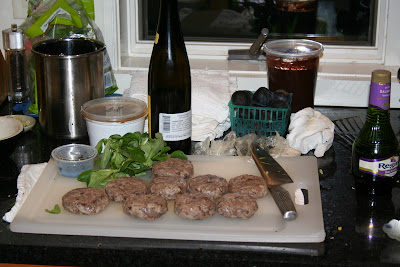
(Rillettes in prep stage)

1990 Chateau Latour~ Paulliac
1966 Chateau Gruaud Larose~ St. Julien (not pictured)


Fourth Course

Pink Peppercorn Crusted New Zealand Veal Rack - truffle scented heirloom eggplant and lingonberry demi glace


1995 Colgin~ Cabernet Sauvignon
2000 Inflagrante SQN~ Syrah


5th Course
Coconut Milk and Rum Braised Short Rib
With mole sauce and savory baked ricotta


2003 Harlan Estate~ Cabernet Sauvignon  
2006 Erna Schein “Fat Boy”


6th Course
Roasted Black Mission Fig – gorgonzola dolce, pulverized prosciutto, pistachio and honey


1971 Chateau d'Yquem~ Sauternes


7th Course
Chocolate Espresso Pot d’crème with blackberry


1963 Graham's Vintage Porto


Chef Contributors: 

Paul Bouchard, Matt Crist and Robert Lhulier
Wine Inspiration:
D. Paige and Ron Bouchard

Tuesday, October 5, 2010

On Sharing Good Wine, Part II


A "blue moon" is one of those over-used superlatives indicating something so rare and so fancy-pants that everyone should take note.  I admit it's both fun, but trite to use, but then my friends and I didn't really consider that when we dubbed what we thought was a once in a lifetime opportunity to taste uber-rare wines, while attempting to pair lofty cuisine worthy of their pedigree, would be the first of...more?

While a true lunar blue moon occurs when there is a second full moon in a calendar month (that's about 7 times every 19 years), we truly thought our opportunity was more akin to the mythical type (you know- like almost never?) than the literal.  Yet, math was on our side.

Last year, I blogged a dinner amongst these same friends that documented the very scenario above.  Given the enormity of it's rareness, we thought we were not likely to see one again, any time soon.  It featured some of the most precious and sought after wines in the world- including a 1975 Chateau d'Yquem, multiple first growth bordeaux, a 1963 Vintage Taylor Port and a 1919 Chateau Haut Brion, all provided by a passionate food and wine lover simply because he saw the enthusiasm with which we produced the first menu.  It was, like the first time 10 years earlier, a night to remember. 

Two months ago I got the call that our benefactor was coming back to town for business, and he wanted to do it all again, just 14 months later.  As with the first two times, he chose 12 wines from his expansive and impressive cellar, emailed us the selections, and then shipped them overnight with painstaking care.  Except this time, we had not six weeks to prepare a menu and line up our game plan, but three.   

When faced with the prospect of pairing world-class wines from first-rate vintages, you don't think about busting out the molecular gastronomy and culinary bells and whistles.  It's all about the classics.  Example:  a pairing from the first dinner 10 years earlier, which will forever be indelled in my memory, was as simple as it was brilliant.  A 1962 Domaine de la Romanee-Conti "La Tache" was paired with a locally raised, braised rabbit leg with parsnips and local mushrooms.  Simple.  The rabbit was simmered until "confit tender". 

It wasn't until days before our seafood purveyor, of all sources, queried whether we'd be interested in taking some fresh Maine wild blueberries that were being brought in by the same guys who were shipping day-boat halibut.  The answer was a resounding, "DUH?".  And so, to bridge that all important gap between what could be a white wine course or a red wine course, we added the berries to our braising juices and let them simmer.  The result defines the term "sublime" (there was another impressive Burgundy paired with the dish from an equally impressive producer and vintage- but, the la Tache was so incredibly on point, and our elementary rabbit dish was so wonderfully complementary, that it silenced our group).  Its extraordinary complexity and delicateness commanded a moment for us to regroup our thoughts before continuing.  The perfect balance of components, married with a harmony of fruitiness, acidity and earthiness leaves me swooning to this day.  Such is the power of the classics.

Sticking with that formula, a forward team that consisted of just myself and my surrogate "chef brother" Paul met one steamy, humid Sunday eve last month to handle the latest challenge.  We gathered our notes on the latest round of wines, and, to lend some inspiration, we opened and reverently sipped a 1990 Chateau Latour.  As is common, we aligned the wines in order of likely service and fleshed out an outline of the basics:  main component and main flavor profile.  With 12 wines slated for consumption, we decided to pour two per course, with the dinner lasting at least six courses (supplementary wines are often added by equally passionate attendees).  But, we knew the crux of how it would all go down.  We had only three days after that to consult a couple other possible chef friends who would participate to fine tune and finalize the menu, order our special ingredients and prep.  All this while working our full-time jobs, managing our personal lives and performing our duties as Pere de la Maison.  Challenging? Yes.  Fun? Of course!  Nerve racking?  Well... you answer.  The previous two dinners had consisted of no more than 10 attendees, and the most recent was looking more like 7 or 8.  No matter, it like the others, had to be perfect.

Why does great wine command such respect and awe?  Like architecture, it's man's greatest achievement of harnessing nature to produce a product solely for the purpose of his pleasure.  

The menu was finalized and the pieces fit into place, as they so often do.  Pairing food and wine is an art, yes- but, it also becomes an exercise in common sense.  Delicate wines require delicate preparations, aggressive ones need a little push.  Never repeat ingredients.  Create diversity of textures and temperatures.  Contrast and complement.  Multiple courses should build in intensity then back down- begin gentle, finish gently.  Leave the table sated, not stuffed.

Despite how it may read, the following menu and wines were the final choices, and they followed all the guidelines above.  The pictures, of course, tell the real story.

Warm up: A little pre-game with Charles Gardet & Co.


1st Course
Ragout of Veal Sweetbreads “Blanquette”- with beech mushroom, local sweet corn, tarragon and veal jus (not pictured)

2000 Chevalier Montrachet~ Bouchard Pere et Fils
2000 Montrachet Marquis de la Guiche~ Joseph Drouhin


2nd Course
Braised Oxtail over quinoa and Doctor Martin lima beans - with thyme infused braising juices

1989 Chateau Mouton Rothschild~ Paulliac
1989 Chateau Lafite Rothschild~ Paulliac
A little "fuzzy", I know- but trust me. 


3rd Course
Crispy Colorado Lamb Rillettes – risotto style “potatoes” and hen of the woods mushrooms 
(Rillettes in prep stage)

1990 Chateau Latour~ Paulliac
1966 Chateau Gruaud Larose~ St. Julien (not pictured)


Fourth Course

Pink Peppercorn Crusted New Zealand Veal Rack - truffle scented heirloom eggplant and lingonberry demi glace


1995 Colgin~ Cabernet Sauvignon
2000 Inflagrante SQN~ Syrah


5th Course
Coconut Milk and Rum Braised Short Rib
With mole sauce and savory baked ricotta


2003 Harlan Estate~ Cabernet Sauvignon  
2006 Erna Schein “Fat Boy”


6th Course
Roasted Black Mission Fig – gorgonzola dolce, pulverized prosciutto, pistachio and honey


1971 Chateau d'Yquem~ Sauternes


7th Course
Chocolate Espresso Pot d’crème with blackberry


1963 Graham's Vintage Porto


Chef Contributors: 

Paul Bouchard, Matt Crist and Robert Lhulier
Wine Inspiration:
D. Paige and Ron Bouchard

Monday, September 20, 2010

On Sharing Good Wine, Part I

I am truly blessed.  One of earth's earliest pleasures has, for one reason or another, been at my disposal it seems as long as I can remember cultivating a love for it.

In my early days of serving table, I became enticed by the various varieties of wines I was called upon to open and serve:  beaujolais, chablis, cabernet.  I admit there was a certain curiosity of what was in that bottle that made the customer choose that specific wine, vintage or producer, and, more mysteriously made their face light up when they tasted and approved it for pouring. 

I began to notice a trend in producers that were on the lists of restaurants I cut my chops on.  Georges Duboeuf, Robert Mondavi, Louis Jadot, Beringer and Moet et Chandon: the gateway wineries.  There was so much I didn't know.  As is common in the business, there was always an incentive discount for purchasing these wines as an employee (at least among smarter operators) which I found both attractive and unavoidable.  I could taste the product I served at a cost usually cheaper than retail?  I'm in.  And, often if an entire bottle wasn't finished, it would hide quietly on the pantry shelf until ring out when it was taken home to study and dissect.

One of my first trips to a "better" wine shoppe gives me feelings of both nostalgia and hilarity. Staring at shelves that held stately selections such as Sterling Vineyards, William Hill and Trefethen Vineyards, alongside the more attractively priced and pedestrian Fetzer and Gallo wines, was a dizzying prospect, at best.  All in a tiny storefront where pipe tobacco wafted regularly from the same store clerk who was in charge of the thermostat.  As I snaked down the aisle, I was batted back the other direction upon reaching the boxed wine and massive jugs of Carlo Rossi.  It was like wine pong.

I was going to need some help.  Which bottle do I gamble on?  Which wine was going to give me the most bang for my buck?  How could I know that what I was about to buy didn't suck?  At that time, Wine Spectator and the more cerebral Wine Advocate were the publications to help navigate the aisles of tantalizing choices.  Numeric ratings and a few sentences of how the wine fared in blind tastings were printed right alongside the price.  But, just when I thought I had discovered the Cliff Notes of the wine world, I discovered a thin wafer of a book on tasting and identifying wines.  It seemed kind of nerdy, but at the same time, there was something about it's thoroughness and approachability that made it easy to give up the $12.95.  Kevin's Zraly's Windows on the World Complete Wine Course was the Rosetta Stone of grapetopia.

I devoured this book and took all the advice it offered from deciphering labels to pronunciation.  It threw bizarre terms at me and tossed about various languages that made me feel as though I had stepped off a plane in another continent.  I wasn't intimidated, however.  I drank it in.  It demystified wine: I was learning something.  Grenache was a grape, not a cake filling.  Riesling was not pronounced with a long "I" sound.  And, chianti did NOT always come in a bottle *slash* basket.  Wine is geography- learn about wine producing regions, and you are learning about wine (same with food, actually- especially in Italy).  When I found out that being presented the cork at tasting was not just a formality, but a silly one at that, I kept it to myself.  After all, any concerns about a wine that might arise from the look, feel or smell of a cork should have been picked up on by the sommelier or person pouring said wine.  I felt like I had turned a corner.

I had read somewhere that a budding sommelier candidate had spent the equivalent of a year's salary hunting down quality wines and producers for the sole purpose of tasting.  He was speeding up the process of cataloging flavors and aromas, whereas some people spend a lifetime.  He was learning a vocabulary for describing what he was tasting, and, would eventually be serving.  It was only a matter of time after that he would be able to use that vocabulary to choose what he thought then was a proper pairing of wine for food.  But, a sommelier needed to know much more.  For example, when presented with the prospect of actually memorizing (so say nothing of remembering) which vintages were the best and for which region of the world, it seemed a daunting task that would only come some day in the future with mastery.  Proper service, presentation, temperature- and the nerve-racking table-side decanting- were all part of the sommelier's duties.

As I continued to dig deeper, I discovered the side projects of wine giants: Opus One, Dominus, and Insignia.  I tried my first barrel sample.  Toured my first winery.  Decanted my first bottle of port.  And, then after a few short years of burying myself in book knowledge, I had the privilege of tasting my first, first growth bordeaux, a 1982 Chateau Mouton Rothschild Paulliac.  I was stupefied.  I had read about it.  Heard about it.  Studied the magnificent, unique labels from some of the most renowned artists in the world.  But, after tasting it, I pondered: how could this mysterious, sensuous and sophisticated beverage taste so incredibly delicious?  I was back to square one.  I knew nothing about wine.

Well, nothing except the most important thing of all:  the best way to learn about wine was to drink it.  The best way to appreciate it, is with friends.  And, no matter how much you think you may know, you will never know all there is to know about wine.  The people I do know who are most knowledgeable about wine, are also the most gracious, humble and generous people I know.

After that experience, each time I happened upon a stellar bottle to save or put in the cellar, I found a justifiable reason to open it and drink it (see above standards).  Whenever presented with the possibility that I may never get to try a wine of a certain caliber or vintage again, I drink it, appreciate it and am grateful.  And wiser, too.  For, just when you think you'll never taste it again- you do.  And it's even more enjoyable because your memory of the first time returns, and a smile creeps across your face.  And suddenly, you can remember who was at the table when it was opened, what you were eating, what time of year it was, and yes- even what it tasted like then.  Thus is the power of magnificent wine and friendships.  I'm certain that I've tasted some really incredible wines while dining alone or at a trade tasting.  But, I can't remember them.  There's no connection to what was in that bottle for me.  A pop of a cork, a raise of an eyebrow, a swish and a swirl, and it was quickly relegated to my short term memory along with seven-digit telephone numbers and locker combinations.

I dedicate this post to everyone- friends, customers, employers, employees, family and strangers- who has ever offered a taste of a wine they opened for themselves and decided it was too good not to share.  I raise my glass to you.

Friday, August 28, 2009

Once in a Blue Moon...


Once in a great while, an opportunity arises for foodies.  A chance to sit down with good friends, drink great wines, eat wonderful foods and enjoy an evening you'll remember for years to come.  Except, if you happen to cook, and you also get to cook with those friends, AND sit down for the dinner- it's an even bigger blast, as anyone who has done it can tell you. 


Nine years ago, fellow chefs, wine guys, foodies and friends (12 in all) got together to experience a generous gift of wine bequeathed to one of our friends from a colleague.  It was a collection of 8 or 9 bottles, including first growth bordeaux from stellar vintages, like 1982 and 1985 & 86.  There was 1966 la Tache burgundy and cult cabernet from California I didn't even know existed (Maya).  And, the mother of them all:  Chateau d'Yquem Sauternes.  
We wrote a menu around the wines, throwing in a couple others to fill in some holes (like Sauzet Montrachets and Grand Cru Champagnes).  We used extravagant, expensive ingredients, but simply, so as to complement these beauties, not kill them.  It was 7 or 8 courses, and it was a once in a lifetime dinner.  Or so we thought.


This past May, the core group assembled again with our benefactor and an entire case of wines that would make any enthusiast weak in the knees.  Then came the news:  among more great 1st growth bordeaux, Chateau d'Yquem, gorgeous white burgundies and Taylor Port from 1963, there would be a bottle of 1919 Chateau Haut Brion.  *Whimper & Sigh* *Jaw drops*


Again, writing the menu around the wines, filling in the blanks with equally remarkable wines and vintages, we met several times before to discuss pairings, view tasting notes and discuss the progression of the meal.  If you've never written a menu of multiple courses or paired wine for them, many factors are considered when doing so.  Building in intensity of flavors, while not losing your navigation is one of these factors.  Throw in ambition, truffles, foie gras, caviar and a previous wine dinner that shook our world, and you've got quite a bit of anticipation, not to mention some healthy anxiety.
It didn't seem possible to have out-done the previous dinner, but it was so. 
Reception- Champagne
Amuse Bouche- Smoked Salmon Cheesecake- with fine herb crème fraîche, Kentucky paddlefish caviar
1st Course- Pan-Seared Canadian Halibut- over melted baby leeks with crisp pancetta
2000 Chevalier Montrachet, Leflaive
2000 Chevalier Montrachet,  V.Giradin
2nd Course- Pan-Roasted Rabbit Loin with sage, Kennett Square mushrooms and olives
2006 Chambolle Musigny F.Mugnier
2001 Charmes Chambertin C.Dugat
1986 Charmes Chambertin
3rd Course- Raviolo filled with Braised Piedmontese Beef Cheeks, Black Truffle and Taleggio; natural braising jus
1996 Chambertin, Jadot
1988 Charmes Chambertin, Roty
4th Course- Spice Rubbed and Grilled Wild Boar Loin with a “reserve” of braised pork belly, cipollini, rosemary and balsamico
1990 Chateau Latour, Pomerol
1990 Chateau Lafite Rothschild, Paulliac
5th Course- Confit of Lamb Leg over roasted beets, braised beet greens with local feta cheese and natural lamb reduction
1990 Chateau Haut Brion, Graves
1919 Chateau Haut Brion, Graves
6th Course- Epoisses with pumpernickel, roasted nuts, blueberry jam and honey
1963 Taylor Oporto
7th Course- A study in Chateau d’Yquem- Seared foie gras over toasted brioche, blue cheese, peach brulée
1975  Chateau d'Yquem, Sauternes
The Cookie- Citrus and Lemon Thyme Shortbread

LinkWithin

Related Posts with Thumbnails