Sunday, March 28, 2010

Humility, When It's Needed Most

You know, one of the upsides to aging is that some of the lessons you learned (usually the hard way) when you were younger come back, not as a clunk on the head, but more like a whisper in your ear.  Very often, and if we are paying attention, we find that those lessons can teach us volumes about ourselves and how we fit into the big picture.

The field of food and beverage is so incredibly vast.  To approach it as a newbie is a lot like running down to the ocean's edge and jumping into the biggest, most intimidating wave with no regard for it's enormous force.  It's exciting, yes- but, there is so much to learn and understand, and respect.  Mind you, I think it's a great way to get into the business- with gusto and passion.  But, with time and a little saltwater in your lungs, you come to understand, this is bigger than you.  And, it always will be.

There are a lot of opinions today.  The world has found more creative and effective ways to get them out into the world through sites like Facebook, Twitter, online posts, blogs, and just plain pontification in public, if anyone will listen.  Hell, this blog is living proof of that, especially if you're reading it!  But, there is a very real danger of people just ingesting and numbing to the internet Kool-Aid.  It's why I'm a big fan of factcheck.org.

I was giving a lecture last month and wanted to check my dates on the Russian occupation of Paris (it was 1815).  I was explaining the etymology of the term "bistro" as it relates to a modern day restaurant.  I had known that the Cossacks, after invading, stormed the boarding houses of the time and shouted "bystro, bystro", meaning "quickly", to demand food and service after pillaging the City of Light.  But, I was amused to see the Wikipedia reference use the phrase, "according to urban legend..."
Excuse me, but when did we go from a commonly accepted explanation of "the origins of the bistro" to urban legend? When just about anyone can belly up to the editing table, it seems, we're dealing only in "virtual facts".  The encyclopedia, as we know it, has gone the way of the pay phone and typewriter.  Obsolete.


The term humility is from the Latin, "humilitas", which depending on how you look at it can mean "humble", something in short supply these days.  Or, my preferred definition from "humus", or "earth", meaning "low" or "from the earth", a great allusion to keeping your feet firmly planted or staying "down to earth".

A lack of humility can be said for experts of all kinds. Foodies are just passionate people who love their comestibles; but then there are the insufferable food JERKS.  People who just don't know when to shut up about what they know.  They want to share every single detail about what they just learned whether we are interested or not.  When they're unleashed on the public (say as a waiter), we all die a little inside.  We feel bad for them because they don't get it. When they get their own TV show, they come off as likable, because they don't challenge us to know what they know- they give just enough information in 22 minutes, buttressed with commercials for celebrity knives and jars of Ragu, as to not offend us and make us think of them as snobs.  Each program is just a slightly different "channel" for the various levels of viewership. This, my friends, is the nucleus of The Food Network. 

The more you learn about food and wine, the more you find there is yet to learn.  All the lessons of life can be learned in the kitchen.  Discipline, respect, failure, success, sharing, love, death (if you've ever killed a roast beyond recognition), and yes, humility.  So, when the waters gets kinda rough out there, strap on an apron, open a bottle of wine, put on some tunes, take a deep breath and sail the open seas of generations of cooks before us! 

Charlie Trotter had this to say in dedicating his third cookbook, Seafood: "to some of the true giants of the food world, Jean Banchet, James Beard, Paul Bocuse, Julia Child, Fredy Girardet, Fernand Point, Louis Szathmary, and Roger Verge, from whose shoulders many of us enjoy a spectacular view."

 Well put, Chef.

Wednesday, March 17, 2010

FEELING SALTY

"I'm mad as hell, and I'm not gonna take it any more!!"
When you begin to read daily about idiotic food legislation, especially as it gets closer to home, you can only stay quiet for so long. 

What is with these people?  Assemblyman Felix Ortiz of the New York State Legislature has proposed a bill that would make it an offense for any restaurant in the state to prepare food for public consumption with...SALT.  With each offense punishable by a $1000 fine.  Yes- the calendar is correct- it is NOT APRIL 1.

Seems Ortiz lost his father to a stroke from high blood pressure resulting (or so it's claimed) from high-sodium diet.  Where was Ortiz when Papi was chomping on the pork rinds and soy nuts?  He says high medical costs and poor health is what inspired the bill.  This reeks of special interest groups and backroom funds changing hands.  I mean- salt? Really?

"Biologically speaking, salt (sodium) plays a major role in human health. It not only feeds nutritional mineral elements to our cells, it also dissolves, sanitizes and cleanses toxic wastes from our system. It is this latter function that makes salt such a healing substance.  All classic biology textbooks refer to salt as the cleanser of bodily fluids."  From "Everything you ever wanted to know about salt"
 Okay- so, if we're on the same page that salt is not the evil killer of restaurant goers, let's get on the same page regarding seasoning with salt.  For a cook or chef to not season with salt (and pepper) is like a swimmer who tries to do laps without getting wet.  Salt goes in the water your pasta is cooked in, it goes in the water your veggies are blanched in, it goes on the thick cuts of meat that get braised to permeate and season throughout for FLAVOR.  FLAVOR, folks.  Salt is a naturally occurring substance (you know, like on the periodic table of elements??) in foods.  Fish live and thrive in salty water.  I don't want to hear any flack from neo-hippies about raw veggie, no-salt diets.  You're wrong about flavor.  Seasoned food tastes better.  Period.  If you have issues with your salt intake, YOU deal with it, but keep your legislation off my pots and pickles! 

Salt is a necessary (albeit tiny) component in baking.  The baking process NEEDS salt.  Are you going to tell me now that the great bakeries of New York City are going to have to cut salt from making their breads?  NO salt= no bread.  Idiots.  Before we had commercial bakeries and bread was only made by hand, salt wasn't added because the salt from the hands of the baker and perspiration was all the bread needed to complete the chemical process of yeasts, sugars and salt, also known as fermentation.  
  • Salt slows down all the chemical reactions that are happening in the dough, including calming fermentation activity to a steadier level.
  • Salt also makes the dough a little stronger and tighter.
  • Salt impacts the shelf life of baked goods, but its effects depend on weather conditions. Salt is hydroscopic, which means it absorbs water. Consequently, in humid climates, it will trap moisture from the air, making a crisp crust soggy, and therefore shortening shelf life. In dry climates, however, the salt helps hold water in the bread longer, inhibiting staling, and thus extending the bread's shelf life.
  • Salt, of course, adds flavor to baked goods. It also potentiates the flavor of other ingredients, including butter and flour.


But enough about salt.  Let's talk about legislation in schools.  The same progressive city of New York is now sticking their heads in public schools and dictating not only how many bake sales can be held a month (ONE), but what can be sold ("Taking the Bake out of Bake Sale")  Otherwise, only fruits and vegetables and any of 27 packaged items that meet city Health Department guidelines on calories, fat and sodium (again with the sodium) can be sold at schools.  I'd love to know what those 27 packaged items are, who came up with them, and what connections those people have to the companies that produce, market and sell them.  More Nanny State b.s..  I don't see the State or City Legislature going after McDonalds.  And you know why?  Because they have too much money and political influence- and they can squash just about anyone.  

Now Philadelphia has become the second city (guess who's first) to ban trans fats from ALL restaurants.  Not some.  All.  It starts with things that are fried in trans fats and any spreads.  Then after September 2010, it goes to all trans fats in foods of any kind in restaurants.  

To say that education is the problem seems both obvious and unpopular.  So let's break it down.  This country is too damned lazy.  There is a reason more than half the population is considered "obese".  There is a reason pre-packaged, hi-sodium, high-trans fats foods exist in tremendous abundance today: we are too god damned lazy.  We want it fast, we want it convenient and we don't want to make it ourselves.  And companies know this and create products because of the "need".  Gives disgusting a new meaning.

If we took an interest in our health, our family's health and our impact on each other, awareness would more than serve as a balance.  We are at a point in history with technology and information where practically everything is at our fingertips.  Why do we need ridiculous laws to govern the ungovernable when radio, news and television could do stories on these "dangers".  Why are they only covered when someone tries to pass widespread legislation that hamper our civil rights?  I know there are documentaries out there.  But people pay to see them.  It's like preaching to the choir.  Why not put an hour long special on prime time television about salt and show people why it's necessary, how too much can harm you, a little bit of history, and throw in some boobs to keep people interested.  This country has gone over the edge, I tell ya.

Do we really need to connect the dots for some people?  Do we really need to narrate a not-so-unbelievable scenario that has people buying soggy, taste-free bread because we're unable to trust ourselves with intake?  Do we really want to go into restaurants and ask for the salt shaker (to apply the salt ourselves) before we ask for a menu or cocktail?  Do we really want and need ANY agency to tell us what we ingest, how much and to what degree?  The answer of course is "NO" to all the above.  We don't want or need those scenarios, but they are not far from becoming reality if we don't do something and say something about it.  

The French must be laughing their asses off at us.  "No salt in zee food?! Ahaaahaahahaahaaa!  What next?  U can cook only in purified water?!? Ahhahahahahhaaaaa!"  I'm certain the bottled water lobby has a plan on the table already.

Listen- I'm not a fanatic.  But this is just people in positions of power making STUPID laws because they think WE are stupid.  And unless we say "no", it's going to continue.  It starts with awareness and needs exposure and education.  And how about some responsibility?  A dash of common sense?  Are these fanatical concepts?  Nope.  They just keep us from looking...well, stupid.  


Wednesday, March 3, 2010

F&C Rewind: Ugly Betty Food


I am unabashedly fond of the Ugly Betty ingredients of the food world.  Not literally ugly, but like Betty, unpopular and misunderstood.  Maybe even a little kooky.  As we enter this season of earthy foods, I'm feeling like it's time to put some of these underappreciated gems in the spotlight.  

Brussels sprouts can be found on a lot more menus these days, especially among the small plate crowd.  But, I often hear people say they "hate" them.  So, I'll ask them if they'll try mine.  After scrunching their nose, they taste, and then the light goes on.  "They're not all CRUNCHY like my mom used to make!"  Very often a lot of the unsung veggies whose virtues I am about to sing are improperly prepared.  

Cooking good Brussels sprouts is a two-step process;  first, they need to be boiled vigorously in lots of extra salty water.  I prefer to cut them in half before I blanch them.  It helps them cook faster, more evenly and readies them for the next stage, searing the sprouts.  Pat these little guys dry after you've pulled them out of the ice bath, and put them in a nice, hot skillet or pan, cut side down, with some whole butter.  First, they're gonna steam and hiss at you.  Then, they'll start to crackle letting you know the butter is browning them nicely.  Take a little peek; when they're golden brown, turn 'em over for a minute or two to warm the back side; salt and/or pepper if necessary.  

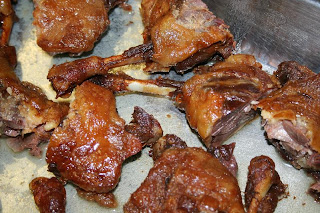
That's the simple version.  The better, more delicious version includes adding smoky bacon at the beginning of the browning stage.  Mmmmmm- baaa-con.  The lardons of bacon, or fat little strips, should brown up at the same time as the sprouts.  So that's good; but wanna make it even better?  This week at the restaurant we're serving an appetizer of Brussels sprouts and bacon, but we're adding to the mix some house-made crispy duck confit and tossing the whole shootin' match with lentils.  Yeah.  It's like that.

Celery doesn't really generate the "ick" factor among people, but it does suffer from the misunderstood veggies complex.  Yes, that's a bonafide medical term, BTW.  Yet, it's versatility of flavor seems limitless.  If you're cooking anything with a liquid base, like a soup, stew or braise, celery is in there along with carrots and onions- called mire poix- because it creates a crucial backbone to the dish.  When you break out of the box and start putting it in your tomato sauce, for example, which when used with say, a Bolognese preparation, the flavor elevates like you can't believe. It's aroma is exotic, almost curry-like.  I've also started incorporating raw celery into dishes.  Salad is the most obvious; it excels in texture and the "fresh" factor.  Added to any mixture of cabbage to create a slaw, it is essential.  And, the tiny leaves that accompany the hearts of celery are both pungent and vibrant in any form of dish, cooked or uncooked.

If you're not into "earthy", it's unlikely you'll become a beet fan, no matter how many tips I give you for preparing them.  But, when I was first learning about the components of foods, i.e. proteins, starches, sugars, acids, etc., a lot of bells went off for me.  There are natural sugars in almost all foods, especially vegetables, but how you coax them out is the key.  For beets, I prefer to roast them.  Roasting is the process of using a slow, steady dry heat to cook a food.  So, if you follow this logic of roasting a vegetable naturally rich in sugars, you're going to eventually remove some of it's moisture, thereby intensifying the sugars.  Roasting beets in their jackets on a bed of salt is my favorite method for enjoying these, the most nerdy of all vegetables.  
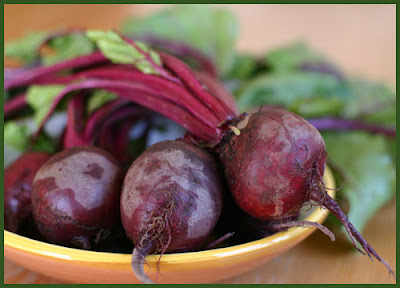
The salt becomes a softer heat source than a metal roasting pan, and as such, doesn't burn the side of the beet that comes in contact with the hot pan.  It also precipitates the reduction of moisture and helps the beets cook faster.  But, enough of the scientific; what roasted beets contribute to a dish in terms of flavor is nothing short of brilliant.  I've had beets and corn that are similarly sweet and flavorful.  When you have a flavor component so vibrant, you can begin to pair it with equally vibrant components.  It's this reason that beets pair so well with brutish cheeses like bleu and chevre.  Sweet-creamy-earthy-pungent is just one of those unlikely, yet heavenly combos that work.  After that, it's just variations on a theme.  Replace sweet for sweet.  Dabble a little in what is fresh; for example, herbs like basil or tarragon.  Or, walk the line on your choice of cheeses in this scenario and you'll be delighted in what you discover.


The same concept of accentuating a food's sugars to produce more flavor can apply to my next wallflower, the parsnip.  This little albino carrot packs what has to be the most unique flavor profile of all root vegetables.  As with all roots, roasting can provide some of the most satisfying results.  Ever had a killer pork roast without potatoes, carrots and onions?  The slow, dry heat is the key.  Adding parsnips to the mix is the icing on your savory cake.  Anywhere you would use a carrot, go for a parsnip.  In soups, the simple addition of diced parsnips leaves people asking, "what was that flavor??"  Boiled, pureed and whipped into mashed potatoes is one of the most revelatory "first" food experiences you can have.  Mounds of pureed potatoes and parsnips with lumps of creamy, rich butter and a dusting of white pepper leaves me swooning for Thanksgiving in March.  As a simple puree soup with a hint of truffle- STOP IT.

So, what about my last ingenue de les legumes, les navet, or turnip.  As a rule, the smaller a vegetable, the more concentrated the flavor.  It's for this reason that a variety of turnip known as the Tokyo turnip is a favorite among chefs.  Go ahead- Google Tokyo turnip Images and see how many shots you get from tasting menus and wine dinners in elite and aspiring restaurants.  Why more popular?  Simple- the smaller variety is first, more appealing to the eye than the baseball sized purple variety.  Second, the sugars are more concentrated, so when cooking, the flavor is more intense.  I used to braise these little buggers in chicken stock, butter and whole vanilla bean.  DAMN, COUSIN!  Talk about flavor!  They make great accompaniments to lamb and other gamy flavors where a natural sweetness creates balance.  A properly cooked mushroom does the same thing.  Shaved, raw turnip on an appetizer or salad is a more mild substitution for a radish; earthy without the spice.  So, love thy turnip, yo.

Thus ends my defense of the downtrodden of all the food chain.  (Well, not ALL the food chain- we aren't talking muskrat, here).  If you've eaten my cooking, you've likely had most of these Ugly Bettys, and you've likely enjoyed them, too.  So, next time you're thinking about eating or cooking them, don't turnip your nose at them.  (No he dittn't).  Embrace your inner Betty and walk on the Ugly Side. 

Tuesday, February 16, 2010

A Belated Valentine: Sade Returns

There is something to be said for an artist who can take off TEN years from making an album and still be relevant.  It seems many of my favorite artists do this.  They keep me entertained for several years on their scant portfolio of music, almost creating a greater appreciation for their art.  And then one day, a new work comes out and you find that all that you loved once about that musician has returned in glorious, gleaming aural beauty.  Yes, the artist formerly known as Helen Folasade Adu is one such artist.  Sade has returned, as fresh as ever.

I confess a certain crush on her beauty.  Born in Nigeria and raised in Britain, Adu makes 50 look like the new 30.  My wife was born in Ethiopia and raised in Italy.  There is an undeniable intrigue about a woman whose playground has been the world.  They carry themselves differently, they age differently and mature with the same velvety sensibilities as fine wine.  

Granted, many people pigeon-hole Sade as one of those VH-1 performers who wind up in the dreaded "Adult Contemporary" category.  And with Sting, they'd be right.   The video for the new single, "Soldier of Love" is contemporary and shows maturity(even if a little Janet Jackson-esque), but I'd hardly call her washed up or ready for an exorcism on "Behind the Music". 


Sade's voice is one of the most recognizable on the airwaves.  It is sultry, educated, firm and lilting all at once.  On "Soldier of Love", the latest release and single, the first words are sung after a commanding new wave tango beat and trumpet call- and you ask yourself, "Is this Sade?"  Yes.  Her voice has matured and sounds to have dropped an octave, that is until she begins a refrain about losing the use of her heart, but still being alive.  "I'm at the borderline of my faith. I'm at the hinterland of my devotion."  This is Sade's "Frozen" period.  

Just like Madonna, Sade and her long time producer Mike Pela, have found the proper polish for her bronze voice with lovely instrumental couplings.  "Morning Bird" has the very familiar feel to the "Love Deluxe" years, but with the addition of undoctored solo piano, it's an amazingly fresh sound.  Sade shows the healthy range of her voice in between haunting cello, piano and a barely audible arabesque tambourine beat.  This type of empty-room, musica triste sound is what can be found on another of my favorite artists' newish releases "Antidepressant" (2006) by Lloyd Cole.

"Be That Easy" is a lush, lazy waltz with reverberating psycho-billy guitars and snare brushes that could easily be a Julie Cruise tune written for a David Lynch film were it not for the warm layered harmonies.  Instead of scaring the shit out of you, it makes you want to pull up a big heavy quilt and watch the snow fall as you drift off for a monster nap.

As the album progresses, it doesn't seem possible the sounds could get more lush, but they do.  "In Another Time" sees the first appearance of the trademark saxophone we all associate with the Smooth Operator.  Heartbeat-type down tempo beats are another signature of many Sade tracks.  "Skin" lopes along with the same kind of retro-soul beat of an even more chill version of "Sexual Healing" from Marvin Gaye, as she simultaneously references "Michael- back in the day".   If you're thinking this is the perfect Sunday Album, you would be dead on.  There is so much to like on this release that when you consider how long it's been since her last release, it makes you a little giddy and a little sad all at once.  A mere 10 tracks and just over 41 minutes, less is definitely more.  


With lyrics that reference the moon, birds, love warriors and lost chances, flames and a safe hiding place for your broken heart ("The Safest Place"), "Soldier of Love", as with all six previous releases, reaches for the inner heart strings of anyone who has ever loved the music Helen Sade Adu makes for the world to enjoy.


Wednesday, February 10, 2010

It'Snow Joke!

I like snow.  Really.  I think it's fun, and I love the buzz it generates.  I especially love cooking for people when it snows.  When you're a kid, you can't wait for school to be called off and get out and romp around.  As an adult, you can't wait for WORK to be called off, so you can- well, you get the idea.  But, there's a certain amount of anxiety that develops when your job is chef and it snows in biblical proportions (not that there was ever a blizzard in Israel, but...nevermind). 

You see, 90% of you are thinking about work on Wednesday, school and any events going on.  You might even be concerned about Thursday since this mess is supposed to carry over.  But, while all this snow business is going on, we chefs are wringing our hands and cracking our knuckles over some details that we have only minimal control over.  What am I babbling about?  This weekend.  Are you there yet?  No?  Valentines' weekend and President's day weekend?  "Ooooohh- THAT!"  Yeah-that.  

Many people think that Mother's Day or some of the other biggies hold title to "The Busiest Restaurant Day of the Year", but you would be wrong.  Saint Valentine's Day and restaurants are intimately and perversely intertwined.  And, if you must know, when the 7-year cycle rolls around placing February 14th on a Sunday, that's not ONE, not TWO, but THREE opportunities to capitalize on famished lovers and canoodling couples.  "But, " you say, "it's supposed to be a beautiful weekend?  What's the deal?"  

Well, here's a little inside look at some things you might not think about.  
In order for a restaurant to promote a big weekend, it needs to settle on a menu well in advance that it can hoist up the flag pole.  It needs to get the word out.  Ads are placed, emails sent, literature printed.  Then, food needs to be ordered.  Now in a market of perishable goods, some items can be ordered in advance, some cannot.  We are not necessarily in command of, no matter how technologically advanced our society, the days which purveyors deliver and the availability of product (especially fresh) when it snows.  (Interesting aside:  fresh fish and seafood ALWAYS gets bumped on continental flights for two priorities:  fresh flowers and dead bodies.  True story.  Apparently, despite the TRILLION dollar world-wide industry of food service, the burial business trumps all.)  So, if you're following, we have an in-progress secondary blizzard falling in the middle of the week, an impending monumental and crucial restaurant weekend on tap, and the threat of power loss, mass-cancellations, and nowhere to park.  Pass the Tums.

Yes- it can be a little slice of hell if you're not in control of your wits.  As an owner, I remember following the weather in winter like a bookie follows the ponies.  When I lived at the shore, it was the same:  rain, or even worse, hurricanes, can trash your anticipated revenue, and most often, on misguided meteorological reports.  I remember one Labor Day weekend in Cape May, I went online to see the forecast.  It was- how shall we say- too "glass half empty".  So I wrote a forecast that was "glass half full", printed it up and directed the front desk clerks to read this, "the latest forecast" to nervous travelers.  

So, this wasn't really so much about venting a neurosis as much as just offering a little insider info on what it takes to pull off a successful (i.e. profitable) restaurant venture in a lousy economy with nefarious competition and increasing operating costs.  Most logical human beings, upon being presented with all this information, along with overhead costs, skyrocketing utilities, high-turnover and low profit margin, would ask- WHY??  Well, nobody said we were logical.

But, when the dining room fills up and guests stare eye-to-eye at each other and order the chef's specials and a luscious bottle of wine while enjoying the music, lighting and atmosphere of a full, humming restaurant, somehow, just somehow- it makes it all worth it. 

LinkWithin

Related Posts with Thumbnails